In our understanding, VIRTUAL is some form of representative/descriptor of the REAL. In quantum mechanics VIRTUAL particles are representative of, though perhaps not fully condensed, REAL particles. In order to look at all the subsystems of our condensed universe that we call REAL, first let’s look at a mathematical expression written down by Galileo. It’s called THE SQUARE/CUBE LAW.
I put a division sign between “square” and “cube,” because the law compares the ratio of surface area to volume of all subsystems. It establishes that spheres of bigger average radii (and larger volumes) have relatively smaller surface areas than smaller than average radii (You can divide the surface area of any volume by its volume and you will see that the ratio of surface area to volume will vary inversely as r (the radius of an average sphere).
What can we learn from the above results of The Square/Cube Law?
- The simplest descriptor of a space/volume is its boundary/surface. (starting out as an sphere of average radius)
- An object/system cannot exist (to-us/to-our-sampling) without some form of descriptor/boundary.
- A boundary is not part of a closed-system/closed-set. https://en.wikipedia.org/wiki/Boundary_(topology)
[What distinguishes existence from non-existence in terms of available energy, and what preceded our universe’s existence, often framed as the question of what occurred before the Big Bang?]
This third take on the system/set, that the boundary is not part of a closed set is crucial. We see that a descriptor/boundary is a simple language, or INFORMATION about the system and not the system itself. So how do we distinguish between the outside (not part of the REAL system/closed-set) and the inside volume encapsulated by the boundary?
Take a circle to represent an object. The space within the boundary is, in our universe, the amount of spacetime present (until available energy is lost through work like expansion, for example). And the boundary itself is the surface through which the system interacts with everything else. [Of course, there are any number of thicknesses and complexities to these boundaries (of fluid fields, or gravitational fields) that may be represented by any number of higher-energy force fields (like EM fields), but the boundary is where the relationships between objects/subsystems-of-the-universe arise.)
An empty volume, empty of internal complex boundaries, is what we might call spacetime, or the opportunity for things to happen (somewhat similar to the transparent volumes of outer space). As boundaries grow inward and electromagnetic [EM] fields evolve, we can characterize any volume by the amount of internally constrained boundaries it possesses by using a fractional nondimensionalized number called the fractal dimension (fd). The fd goes through the whole-numbered dimensions (3 to 1), but it also registers the values of the fractional dimensions.
What’s nice about the fractal dimension (fd) is that as a system boundary becomes internalized, the system can usually do more things depending on the complexity of the bounded constraints. As relationships develop within and between systems in time, so the fractal dimension goes from 3-D toward 0-D. We call this change with time of the fd, THE MIDRANGE SLOPE OF THE FRACTAL DIMENSION [for more information see Wolfram’s A NEW KIND OF SCIENCE: https://www.wolframscience.com/nks/]
At the end of the setting down of internal boundary in a given universal subsystem, we have something like a supermassive black hole, that is all boundary and very little of the original spacetime (nearly 0-D).
That boundary of an object/system, and its increasing complexity is, also, moving to a higher ordering of information. The original 3-D state of the simple boundary (a volume of fd of about 3-D) is an interesting state (and is, in my estimation, the most misunderstood). The initial state of volume is considered a chaotic static, where no pattern can be found in this state [aka the quantum state].
What does it mean when we say [by Galileo’s Square/Cube Law] that larger volumes have relatively smaller surface areas than smaller volumes?
In the biology of living cells, it means that the smaller the cell, the more important is the surface area. Sponge/Phyllum-Porifera OPEN reefs were important in maximizing exposed surface areas (of cells) to the environment. OPEN here means the living cells of the multicellular reef organisms depended heavily on the pores of the multicellular organisms for exposure of each cell to environmental nutrients. In time, these open reefs evolved into closed ones.
Alternation of generations in the tunicates [https://www.britannica.com/animal/tunicate] resulted in their free-living swimmers and eventually led the notochord vertebrates onto the land, evolving into us vertebrates, CLOSED system sponge reefs. [When observed under high magnification [like seen in SEMs: scanning electron microscopes] human (and other mammal tissues) appear like sponge tissue.]
What does the living cell story, above, tell us about the usefulness of maximizing surface area for volume? In any system, the bigger the surface area per volume the greater the exchange with the environment. What this (Square/Cube) means is smaller systems naturally have more effective interaction with their environment than do larger systems, and so are more energetic (have more available energy).
A byproduct of observing droplet boundaries [in my (S.B.K. Burns and S.G. Advani) research: https://link.springer.com/article/10.1007/BF00191691] for unstable behavior, showed that the more unstable the droplet, the more it vibrates/oscillates due to random vibrations. This can be seen in the Navier-Stokes General Energy Equation when the changes/derivatives of time are forced equal to the changes/derivatives in the surfaces or boundaries. When changes in time are equated with changes in space, we find the frequency of oscillation (of the expanding droplet). For unstable droplets, the number of oscillations in time imprint/buckle the same number of sine waves on the boundary. A summary of what was learned about the change of boundary curvature with this unstable flow is as follows:
The reason why the above is important is that the resulting interfacial tension of the boundary, between water and oil-based fluids, preserves the number of incident sine waves on the boundary (which is equal to the frequency of oscillations in time (due to the same random perturbations)).
Just like with high-massed systems (in our universe) sine wave troughs initiate at a locality and remain fairly stable in time (fairly steady and immovable). Another analog of this gravitational-well/interfacial-tension-well can be seen as water flows around small rocks of high curvature in a stream. The higher the curvature (as in the curvature of the sine wave trough, or gravitational well) the more the rock is kept/forced into place by the flow.
Sine waves deform the boundary of an expanding droplet as they force the droplet to oscillate off center (offset from their original center at rest (the original center is known, since it is the location of the designed near-singularity source of constant-pressure fluid)).
Higher unstable combinations of fluids, like gas flowing into some liquid, produces high-energy situations with more internal boundaries created as the deformed droplet expands. [Important is that in any time, we see the high energy troughs (of our experiment) breaking-up/becoming-disconnected into regions of average circular radius (perhaps similar to COBE images that result from the highest energy initiations).
Now let’s use what we know from the further development of internal boundaries at long times and high-energy differentials across the boundaries to develop a cycle for the creation of mass (as an offshoot of the creation of boundaries). Boundaries might, besides representing descriptions/information, represent entropy (energy loss) produced after available energy is used in doing work.
The fractal dimension (fd) is a good ruler to measure the amount of entropy and mass that an internal boundary creates.
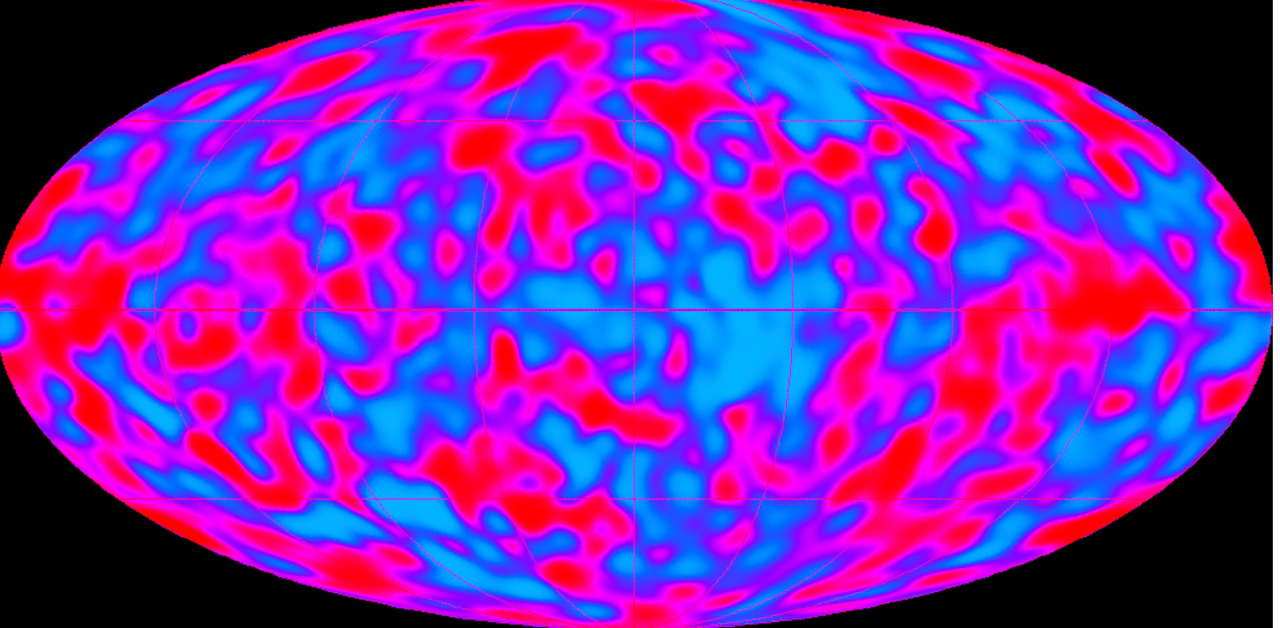
NASA’s COBE (Cosmic Background Explorer) was a mission that measured and mapped the cosmic microwave background (CMB) radiation, the oldest light/temperature/available-energy in the universe.
Notice that this COBE image represents a time after the beginning of the condensation of our universe (from virtual particles in a potential universe). As human observers, the simplest information about the volumes of spacetime, shown, are their boundaries. So, if what we’re looking at is the entirety of the potential universe visible to us (our existing and condensed universe), we see that COBE gives us a look at the internal boundaries (resulting from condensation of super high energy losses) within the potential universe. Again, these internal boundaries and how they develop in time will give us the midrange slope of the fractal dimension. And the midrange slope (from COBE maps at sequential times) will give us the expansion rate reasonably expected from any region within this changing image (this technique may already be used to validate the redshift).
So, the above explanations suggest how we might look at an initial closed-set/system, and how it might attain information/mass/entropy with time. However, we haven’t said anything about how with these givens that consciousness might develop within closed universal systems.
The most profound outcome in our research (even more so than an equation that can predict the two fluids relating to one another across a boundary (see abstract above) and the deformation of such boundary, is how our oscillating droplets “remember” how many times they’ve oscillated.
The energy impinged on a droplet in our experiment is caused by the forces of random perturbations. Just as a tuning fork of different metals oscillates differently (at different frequencies) so our boundary between an inner fluid, that flows more easily than an outer fluid (viscosity contrast), creates interfacial tension on its boundary between the two fluids and so the surface of the droplet deforms by the number of oscillations. [Such a driving motivator of such oscillations is practically nonexistent in black holes and neutron stars, except, perhaps, when they are in the process of merging (as detected by LIGO).]
So, our droplets oscillate offset from their centers, and each time this happens, the outer boundary buckles in the shape of a sine wave. So, our droplets have with them the information about their past behavior by the shape of their boundaries. A droplet that has oscillated six times (before stabilizing) has a hexagonal-like shape made up of six sine waves buckling its boundary (This similar pattern can be seen in the northern hemisphere of Saturn between two atmospheric layers):
By NASA/JPL-Caltech/Space Science Institute – Catalog page · Full-res (JPEG · TIFF), Public Domain, https://commons.wikimedia.org/w/index.php?curid=54482817
A profound disclaimer here: Just because a droplet can count the quanta or number of impinging whole sine waves by how many times it’s offset from its center (and its boundary buckles), doesn’t mean it is conscious (can exactly think about what happens, or what is happening), but for a simple boundary, this is the evolution of the memory connected to its present behavior (the frequency of its offset oscillation) and its past behavior (the number of incident sine waves on its simple exterior boundary).
The midrange slope of the fractal dimension measures how these fluid actions/reactions evolve primitive memory, both external and internal. Eventually, the system becomes more and more aware of the memory with, perhaps, an added conscious ability to manage that awareness.
Available energy in the system decreases as it does work in deforming the outer boundary inward, into the system (this requires a very high energy level on par with the explosive forces of our initial universe). Once this expansive work is done, at the end of this entropic journey of energy loss, this coded information boundary becomes ordered into all the internal boundaries that the COBE image evolves into.
At the beginning of condensation of our universe from a potential and virtual state, action/reaction occurs externally. As boundary goes entropically internal, reaction of a system is internalized (and it, most likely, is where conscious awareness evolves).
[The next post will have to do with why living cells automatically divide (and how this leads to natural selection within the cell and its alternate generation, the multicellular body of the individual’s organs).
The next post will point out evolution in celestial features that evolve from the above behaviors.
And, following, a discussion of how any form of consciousness might arise from the above explained facts, as a product of our research into boundary changes and their stabilizations.]
.
 The Union of Opposites
I’ve read it…!! now try to assimilate, like forming a vacuole on the boundary…
Virtual particles are short-lived, perhaps even smaller than planck length, so difficult to directly sample as random perturbations of the dark energy that first leaked into our universe (possibly through the ZERO POINT (ZERO POINT ENERGY).
Boundaries and their shapes are of long enough duration to sample, and, therefore, we look at them as REAL. Boundaries in time establish the memory of a system (in fractal dimensions (fd) this is called The Midrange Slope of The Fractal Dimension (note: these are mathematical/geometric measurable dimensions (like 0, 1, 2,3,4, and not fractal patterns))